Compliance Is the Answer: Billing with Confidence When Using the Firebox
As towing professionals, you operate in one of the most dynamic and demanding industries in transportation. And now, with the rise of electric vehicles (EVs), you’re being asked to manage new levels of risk — specifically the fire hazards and containment needs of compromised EVs.
The reality is simple: A damaged EV poses a very real threat to your yard, your employees and your business. These vehicles can enter thermal runaway hours, days or even months after an incident. Traditional storage methods are no longer enough.
That’s why the Firebox exists and why billing for its use is not only justified, but essential to recouping what is ultimately a smart, safety-driven investment in your business.
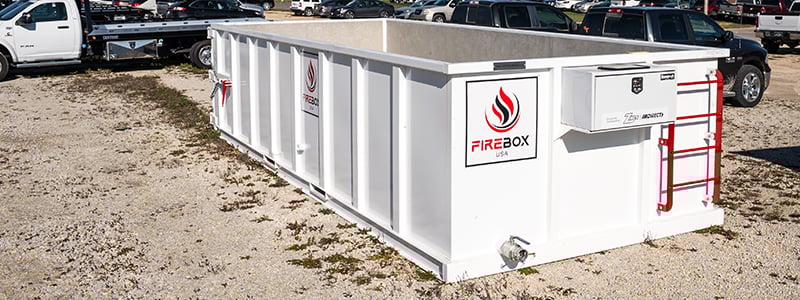
The Firebox is the only true solution on the market designed specifically to isolate, contain and safely store compromised EVs. It’s not a retrofit. It’s not a workaround. It’s a purpose-built containment system engineered to mitigate the growing risk of EV-related fires. For tow companies , it’s more than a safety tool…it’s a liability shield and a revenue opportunity!
And yet, some tow operators are still unsure how to bill for the service the Firebox provides. Whether they’re concerned about insurance pushback or believe their city or state’s capped storage rates prevent additional billing, the hesitation is understandable, but misplaced.
It’s important to understand, this isn’t just storage. It’s a specialty safety and mitigation service, and it’s absolutely billable.
If you receive any pushback or resistance on your invoice — from an adjuster, customer or agency — redirect the conversation to compliance. You’re not inflating costs; you’re following industry-recognized safety standards. That’s where the Energy Security Agency (ESA) becomes your most important ally.
ESA is the national authority on EV fire risk and compromised EV handling. They offer FREE, on-scene safety support to towing, recovery and fire & rescue first responders, providing protocols for how these vehicles should be properly handled, transported and stored. When your bill is challenged, your answer should be simple and direct:
“We are following ESA-recommended safety and compliance procedures for handling a compromised EV.”
And you should bill accordingly. Here are the three primary line items that can and should be reflected on your invoice when using the Firebox:
- Standard Vehicle Storage: Your regular daily storage rate still applies, just as with any vehicle in your care.
- Isolation and Containment: A separate line item reflecting the use of the Firebox as a specialty safety device. This isn’t general storage; it’s a risk-control solution that ensures safe containment.
- Additional Mitigation Measures: If additional precautions are used, such as thermal imaging, smoke detection or live video monitoring, these measures are directly tied to the Firebox’s purpose and can be billed individually or as a bundled charge.
Beyond additional revenue generation, the Firebox delivers two additional benefits that are critical for any operator to understand. First, it preserves your storage capacity. Without a Firebox, a compromised EV may require a 50-foot safety perimeter, rendering numerous nearby spaces unusable. With the Firebox, you maintain those spaces, and the revenue that comes along with them. Second, and perhaps most importantly, it builds your company’s reputation. Using the Firebox shows your community, public safety partners and insurance providers that you prioritize safety, take the EV fire threat seriously and are leading the way in best practices for the industry.
As compromised EVs become more common, the question isn’t if you’ll need a safe containment solution, it’s when. Don’t wait for a catastrophic event to force the decision. Making the mitigation investment now is a proactive move that protects your people, your property and your bottom line. The Firebox provides the only truly compliant, scalable and effective answer on the market. It’s time the industry recognizes its value and not just in terms of safety, but in billing terms, too. Learn more about how the Firebox delivers that value by viewing the complete product details here.
For those who haven’t already familiarized themselves with ESA’s services, standards and protocols, we strongly encourage you to reach out to them directly. You can review their website here.